What will I realistically gross?
Non-Hazmat mileage pay uses a sliding performance scale. Base pay starts at $0.50 per mile. Drivers can earn up to an additional $0.20 per mile in weekly performance bonuses, bringing the all-in rate to $0.70 per mile. Performance factors include making pickups and deliveries on time, avoiding driver-caused delays, keeping the assigned truck in proper order, and maintaining satisfactory inspection performance. These inputs are tracked in True Blue's TMS using Motive data. Each driver receives a weekly breakdown showing mileage, base mileage pay, bonuses earned or missed, and the final effective CPM. True Blue expects a capable, dependable driver to earn the $0.70 all-in rate. At the expected 2,000–2,500 miles per week, subject to freight, operations, and the driver's available legal 70-hour clock, $0.70 CPM produces approximately $1,400–$1,750 gross. Hazmat loads pay a flat $0.75 per mile for the miles associated with that Hazmat load; the performance scale does not apply to that Hazmat rate. At 2,000–2,500 Hazmat miles, expected gross is approximately $1,500–$1,875. Hazmat is strongly preferred, and because True Blue has substantial Hazmat freight, the intention is to keep Hazmat-qualified drivers running Hazmat loads as consistently as possible. No weekly gross is guaranteed.
When am I home?
Full-time drivers should expect to run their available 70-hour clock. As the driver approaches the end of that clock, dispatch plans the next or final load as a home load so the driver can take the required 34-hour reset at home. This is not a home-daily position; home time is planned around the driver's 34-hour reset and actual load cycle.
Where will I run?
Drivers normally start in Reno and operate throughout the Western 11. Frequent lanes include Washington, Oregon, California's Bay Area over the Sierra, and Arizona, with additional freight into Utah and Idaho. Hazmat lanes are especially important in Idaho, Utah, and Arizona.
What am I hauling?
Primarily 53-foot dry-van freight that is mostly no-touch. Drivers may be required to secure loads with straps and load bars. Some Hazmat deliveries involve limited driver unloading: at Sherwin-Williams locations, facility employees are not permitted inside the trailer, so the driver moves the freight from the trailer onto the dock; Sherwin-Williams personnel handle it after it reaches the dock. The approximate operating mix is 40% drop-and-hook and 60% live load/live unload.
When will I work?
Start time is generally in the morning but ultimately depends on dispatch and the load. PetSmart loads commonly pick up in the afternoon; the driver then travels a few hours toward the delivery, takes the required 10-hour reset, and continues. This is a full-time position for drivers prepared to use their 70-hour clock, so weekend work is part of the job. Freight is consistent, but lanes vary; True Blue does not promise a dedicated lane. Home time is planned around the 34-hour reset.
What equipment will I use?
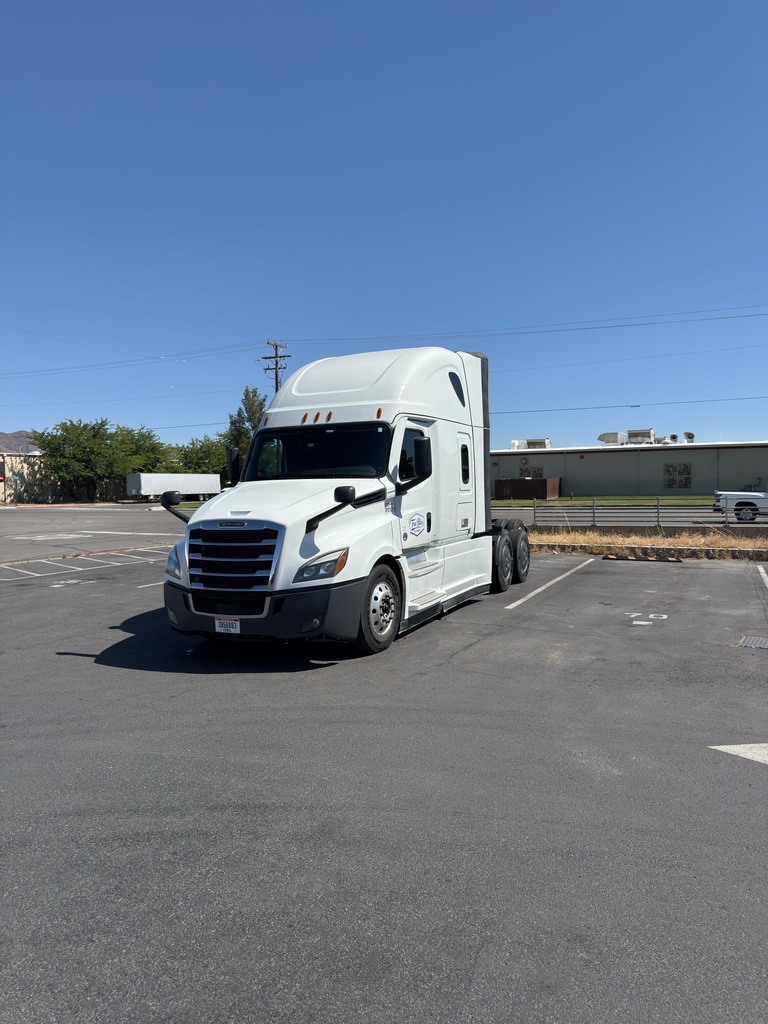
Expected equipment is a 2022 Freightliner Cascadia with an automatic transmission. Full-time drivers receive an assigned truck rather than slip-seating. Leased trucks are governed at 69 MPH and include an outward-facing camera, inverter, and refrigerator. The trucks do not have APUs, and a microwave is not expected but should be confirmed for the exact unit. Drivers are encouraged to take their assigned truck home; if they do not have suitable space at home, they may arrange practical parking close to where they live.
What is paid beyond miles or hours?
True Blue intentionally uses a high mileage and performance-pay model rather than numerous accessorial payments. Extra stops, layovers, breakdown time, driver unloading, chaining, orientation, and brief training are included in the mileage compensation and are not paid as separate accessorials. Detention or waiting time is the exception: it is paid to the driver only when the broker pays detention to True Blue. Non-Hazmat base mileage pay is $0.50 per mile, with up to $0.20 per mile in weekly performance bonuses for an all-in rate of $0.70. Hazmat-load miles pay a flat $0.75 per mile with no performance scale applied to that rate. Non-Hazmat performance includes on-time service, avoiding driver-caused delays, keeping the truck in proper order, and satisfactory inspections, with the underlying activity tracked through the TMS and Motive. Drivers receive a weekly breakdown of the calculation.
When do benefits begin?
True Blue offers optional health, dental, and vision coverage effective on the first day after the driver completes 30 days of employment. The driver pays the coverage cost through a per-mile payroll deduction. The deduction is determined individually after the driver is entered into the benefits system; illustrative estimates may range from approximately $0.08 to $0.20 per mile, but no rate can be promised before the individual quote is produced. Drivers may decline the company coverage and obtain their own insurance. True Blue currently does not offer a 401(k), company-paid retirement plan, PTO or vacation, paid sick leave, holiday pay, or life insurance.
Who qualifies?
A CDL-A driver with at least one year of verifiable tractor-trailer experience, an MVR score of zero, Clearinghouse eligibility, geographic fit for a Reno start and Western 11 operation, and the required physical qualifications. The driver must also satisfy the federal English-language proficiency standard for interstate CMV work: communicate sufficiently with the public and officials, understand highway signs and signals, respond to official inquiries, and complete required reports and records. Hazmat is highly preferred because True Blue has substantial Hazmat freight and pays a flat $0.75 per Hazmat-load mile, but the endorsement is not mandatory.
Why do drivers stay?
True Blue is a small Reno company with four people in the office and direct access to the owners when a driver needs to talk. The company emphasizes honest recruiting and dispatch communication, fast and transparent weekly pay reporting, modern TMS and Motive-supported operations, consistent freight, assigned equipment, and a strong safety and compliance culture that supports valuable broker and customer relationships. Continued company growth may create future opportunities outside the driver's seat. Depending on business needs and mutual fit, a driver may also be able to explore a future owner-operator relationship, operating under their own authority, or using True Blue for dispatch support; these are potential paths, not guaranteed promotions or contracts.